
On this page
Compare spread and commission in the same currency and for the same trade size. A smaller starting spread does not necessarily produce a lower total cost.
List each cost separately
The spread is the difference between bid and ask. Commission may be charged on entry, exit or both, depending on the account terms. Overnight charges and conversion can matter as well. A commission-free label does not imply that spreads or other charges vanish. Read whether a quoted commission applies per side, per deal or per completed round trip.
An illustrative round-trip comparison
Assume the spread-related cost for a hypothetical completed trade is USD 8 with no separate commission. Compare a second account with USD 3 spread-related cost and USD 3 commission on each side: its simplified total is USD 9. In that example the narrower spread is not cheaper overall. These are invented costs for arithmetic, not prices offered by Vestrado. Add any relevant overnight or conversion cost before comparing a held position.
Convert the spread into the same units
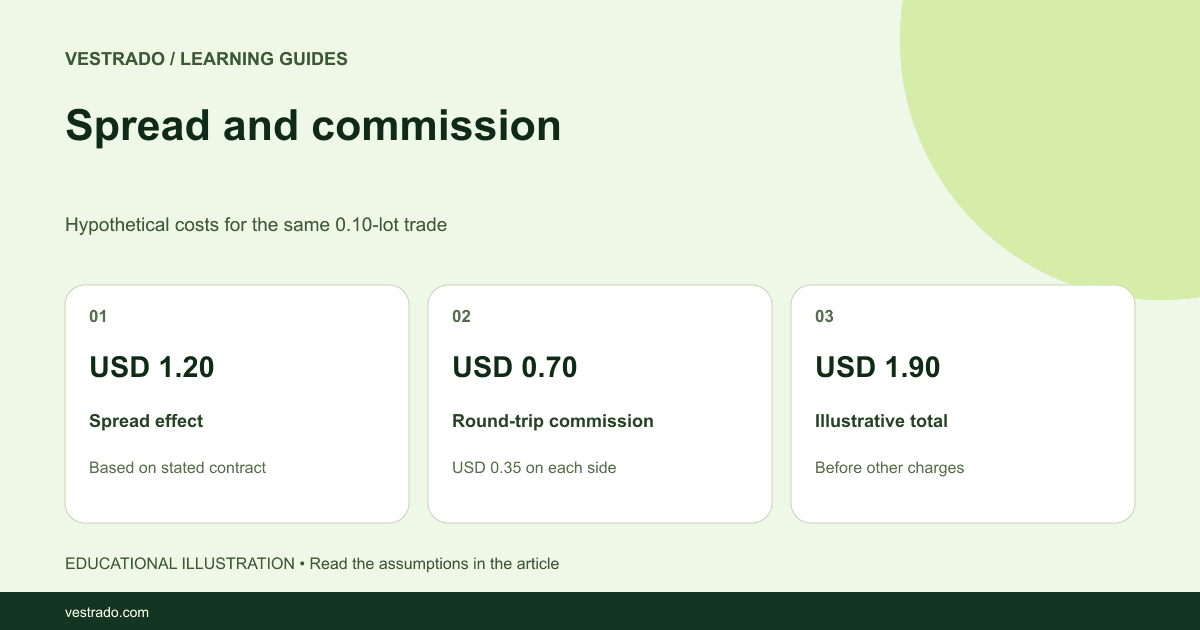
For a hypothetical EUR/USD symbol, assume 100,000 EUR per lot, a volume of 0.10 lots and a pip size of 0.0001 USD per EUR. The exposure is 10,000 EUR, so one pip corresponds to USD 1 for that volume. A quoted spread of 1.2 pips therefore represents an illustrative USD 1.20 spread effect. This depends on the stated contract and quote currency; do not apply USD 1 per pip to another symbol or volume without recalculating.
Now suppose commission is quoted as USD 3.50 per lot per side. For 0.10 lots, entry commission is USD 0.35 and exit commission is another USD 0.35: USD 0.70 for the round trip. Adding that commission to the illustrative USD 1.20 spread effect gives USD 1.90 before financing, conversion or other relevant charges. If the quoted USD 3.50 were already a round-trip rate, multiplying it by two would overstate the commission.
These figures are invented for a unit-conversion exercise. Commission schedules can also use minimum fees, tiers or another charging basis. Read the actual schedule rather than assuming every charge scales linearly with lot size. Use lot sizes and contract units to keep the volume calculation consistent.
Do not count the spread twice
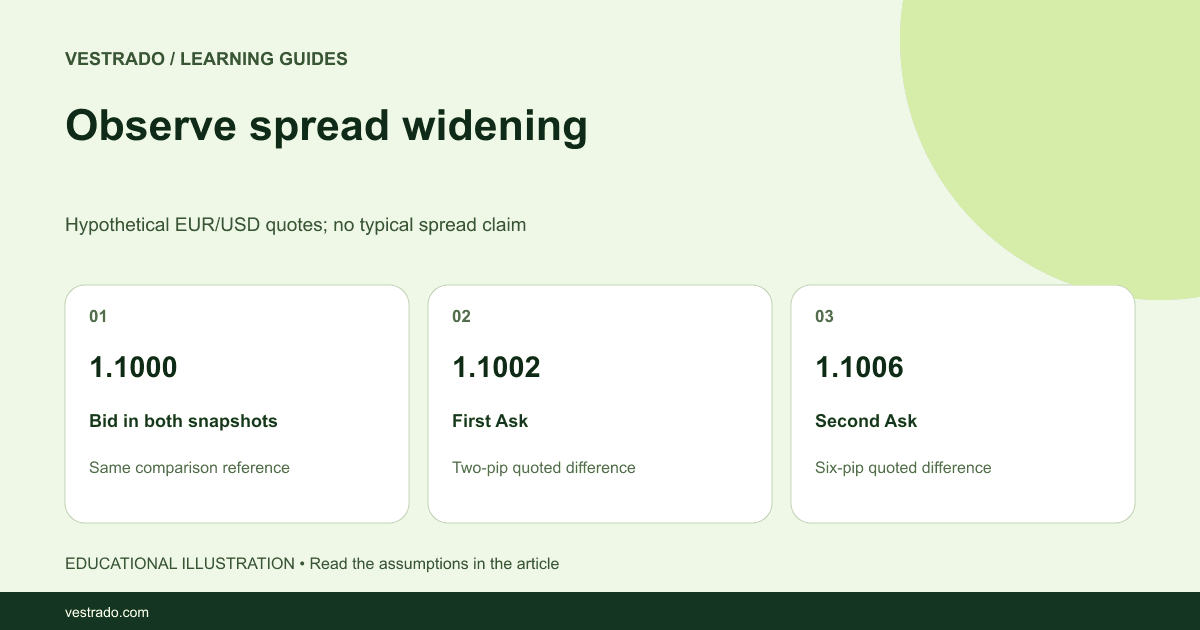
For a simple illustration, assume a static Bid of 1.10000 and Ask of 1.10012. A buy executed at the Ask and closed at the unchanged Bid has a price difference of minus 0.00012. With the 10,000 EUR exposure above, the gross price result is minus USD 1.20. The bid-ask effect is already included in those executed prices; subtracting another USD 1.20 from that result would count it twice. Separate commission and other charges still need to be reconciled.
Real quotes and execution can change between entry and exit. This static example is not a prediction of an actual round-trip result. Distinguish a cost estimate based on quoted spreads from a journal calculation based on actual fills.
Avoid misleading comparisons
Use the same instrument, volume, currency and time window. Compare realistic conditions rather than one minimum spread observed at a different time. Record the source of each charge and whether it changes with volume. Check the account comparison, then confirm your specific terms before funding an account. When logging demo trades, separate gross price movement from net outcome so transaction costs are not counted twice or ignored.
Frequently Asked Question
Is raw spread always the cheapest option?
No. Compare the total under your actual volume and applicable charges. The result can change between instruments, account terms and trading conditions.
Further reading
Compare the current account conditions and leverage and margin information alongside this explanation. Examples are hypothetical, not live prices, Vestrado contract specifications or recommendations for your account.
Trading forex and CFDs involves risk. This educational article does not establish that a product, position size or strategy is suitable for you.


Start your trading journey
Choose flexible trading conditions based on your experience, strategy and trading goals.