
On this page
Leverage and position risk are connected but different. Compare the exposure you hold before comparing the margin needed to hold it.
Hold exposure constant first
For a simplified hypothetical exposure of 10,000 units, a 1% adverse value move represents 100 units before costs, if the account and quote units align. Changing the margin percentage does not itself change that price-driven amount when exposure is held constant. It changes how much margin the rules require. Actual calculations can involve conversion and instrument-specific methods.
Then change the position size
If exposure doubles to 20,000 units under the same simplified assumptions, a 1% move represents 200 units. A platform may permit that additional exposure because less margin is required, but permission is not suitability. This is why using every available margin unit can create much more loss potential than the balance label or chosen leverage ratio suggests.
A forex example with the currencies shown
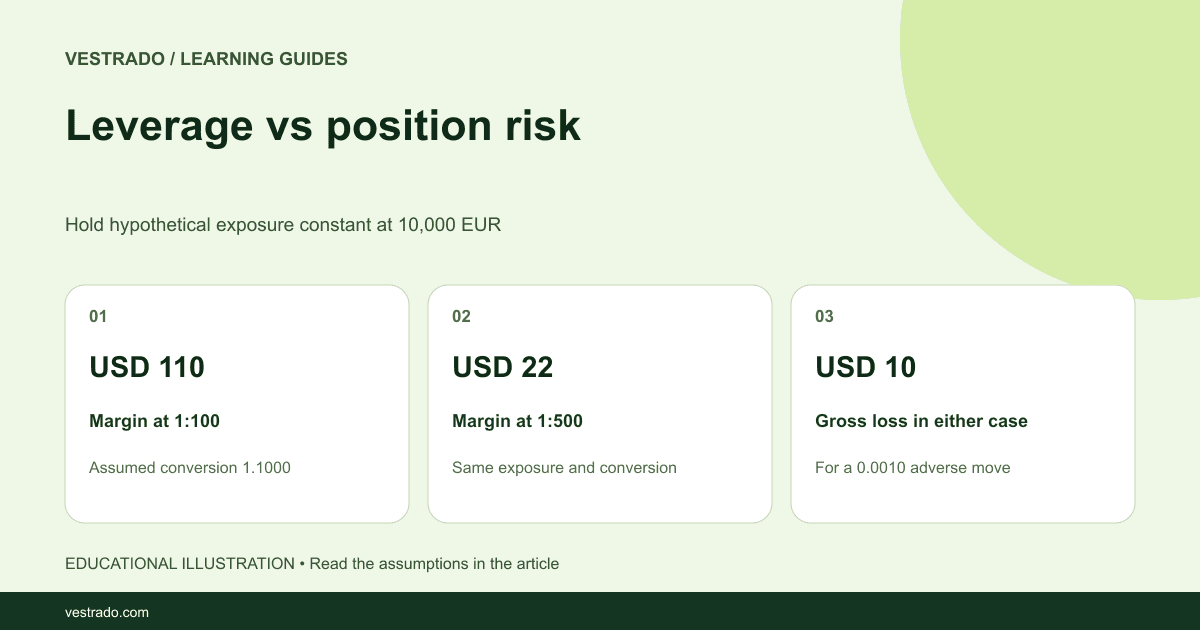
Assume a hypothetical EUR/USD symbol with 100,000 EUR per lot, a volume of 0.10 lots and a USD account. Exposure is 10,000 EUR. Under a simplified forex margin calculation with a margin factor of one, dividing by leverage of 100 gives a base margin of 100 EUR. At an assumed conversion of 1.1000 USD per EUR, that is USD 110.
With the same exposure and leverage of 500, the base margin is 20 EUR, or USD 22 at the same assumed conversion. Those amounts are margin estimates, not trade fees or maximum losses. They are not leverage offerings or required-margin quotes for a Vestrado account. Fixed initial margin, different calculation modes, rates, account positions or changing conversion prices can alter the actual requirement.
Now assume a buy executed at 1.1000 and closed at 1.0990. The price difference is minus 0.0010 USD per EUR. For the same 10,000 EUR exposure, the simplified gross loss is USD 10 under either leverage assumption. Additional costs and conversion into another account currency require separate treatment. Reducing the margin estimate from USD 110 to USD 22 did not reduce that price-driven loss.
What changes when the released margin funds more exposure
Keep the invented conversion and margin assumptions above. At leverage of 500, a volume of 0.50 lots represents 50,000 EUR and has a simplified USD 110 margin requirement. That uses the same estimated margin as 0.10 lots at leverage of 100, but the exposure is five times as large.
For an executed price move from 1.1000 to 1.0990, the gross loss on that hypothetical 0.50-lot buy is USD 50 rather than USD 10. The difference comes from increased volume, not from multiplying the same fixed position's loss by the leverage number. This is a comparison exercise, not a suggestion to use the released margin or choose either leverage ratio. The lot-size guide and position-sizing worksheet help keep those inputs separate.
Keep two separate checks
Write down the planned exposure and a potential-loss scenario, then separately check margin availability and account terms. Never substitute the margin calculation for the loss scenario. Include relevant costs and recognise that an intended stop may fill differently. Use the account comparison to understand current product differences without choosing solely on maximum leverage. Demo practice can reveal calculation mistakes; it does not remove the financial consequences of live exposure.
Frequently Asked Question
Does lower leverage automatically make a fixed position safer?
For the same exposure, lower leverage alone does not reduce its response to a price move. It changes funding and margin constraints; total risk still needs a broader assessment.
Further reading
Compare the current account conditions and leverage and margin information alongside this explanation. Examples are hypothetical, not live prices, Vestrado contract specifications or recommendations for your account.
Trading forex and CFDs involves risk. This educational article does not establish that a product, position size or strategy is suitable for you.

Start your trading journey
Choose flexible trading conditions based on your experience, strategy and trading goals.