
On this page
Position sizing connects a price scenario with potential monetary loss. Begin with units and a hypothetical loss calculation, rather than choosing volume from the available leverage.
Build the calculation from inputs
Record the intended entry, planned exit distance, contract size, volume and account currency. Cash exposure to a price change depends on those inputs and the instrument calculation method. An account balance or minimum deposit alone does not supply them. If the quote currency differs from the account currency, the conversion is another input that must be checked.
An illustrative sizing calculation
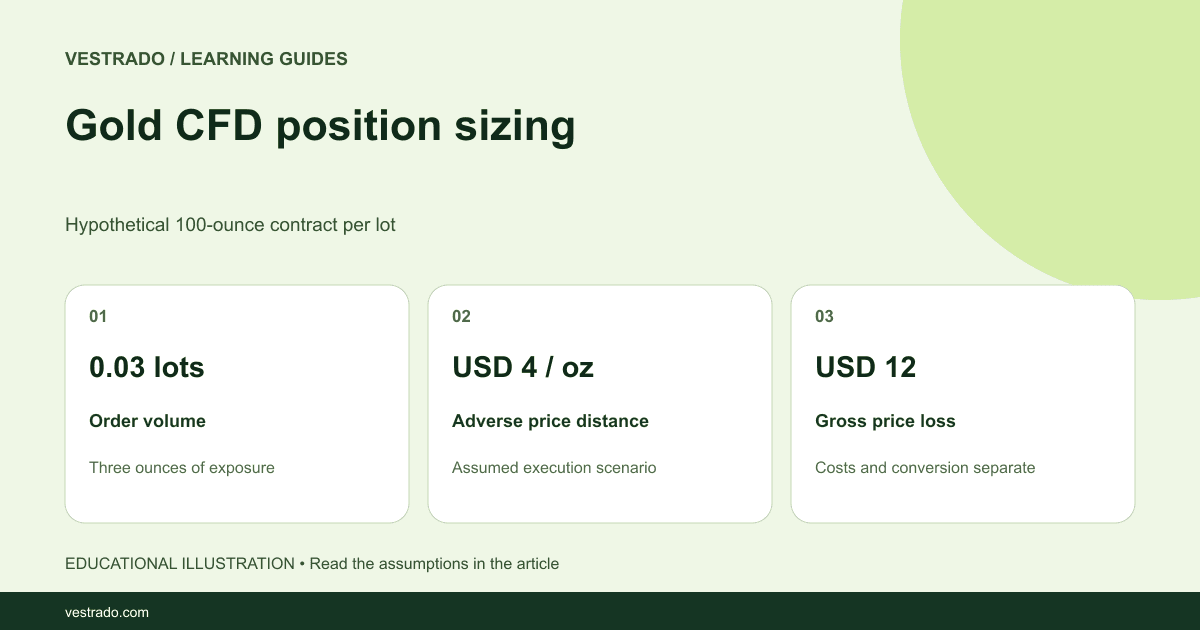
Suppose a hypothetical forex contract has 100,000 units per lot and a planned distance of 0.0020 in the quote currency. For 0.10 lots, the simplified price loss is 100,000 multiplied by 0.10 multiplied by 0.0020, or 20 quote-currency units. If an illustrative budget were 10 units, the corresponding volume before costs would be 0.05 lots. This is arithmetic, not a suggested risk allowance or a guaranteed maximum loss.
Include a cost allowance before rounding
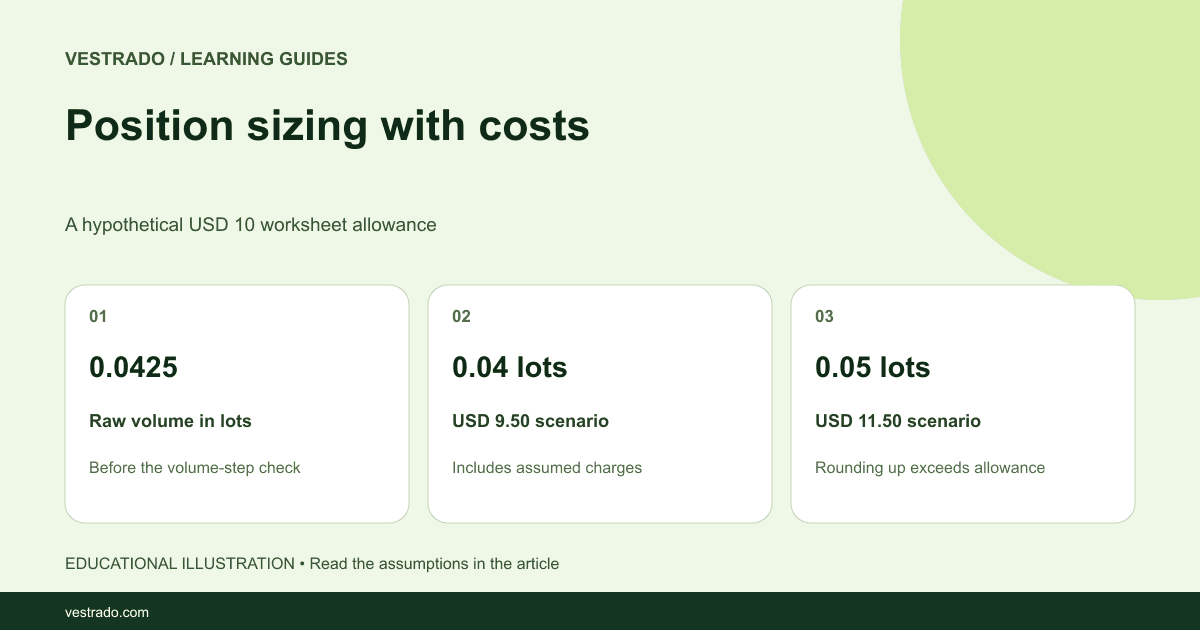
Make the units explicit by using a hypothetical EUR/USD symbol with 100,000 EUR per lot, a planned price distance of 0.0020 USD per EUR and a USD account. Under those assumptions, one lot has a simplified USD 200 price-loss scenario. Suppose the worksheet uses an invented USD 10 total allowance and reserves USD 1.50 for applicable charges. That leaves USD 8.50 for the price-distance calculation.
- Raw volume: USD 8.50 divided by USD 200 per lot = 0.0425 lots.
- If the permitted volume step is 0.01 lots and the minimum is 0.01, 0.04 lots fits the step; 0.0425 does not.
- At 0.04 lots, the simplified price loss is USD 8; adding the assumed USD 1.50 charges gives USD 9.50.
- Rounding upward to 0.05 lots gives USD 10 price loss plus USD 1.50 charges, or USD 11.50, exceeding the worksheet allowance.
The USD 1.50 is an assumed allowance for this exercise, not a fee quote or a reliable ceiling. Actual charges may depend on volume and holding time, so recalculate them for each candidate volume. If the smallest permitted order is still too large for the written scenario, there is no valid volume under those assumptions. Do not increase the allowance just to make an order possible.
A gap, slippage or a change in conversion rates can produce a larger loss than the worksheet. A planned stop is an input to an estimate, not a promise of execution at that price. See the spread and commission comparison when separating price effects from additional charges.
Recheck the currency and calculation method
Keep the price distance, contract units and monetary allowance in compatible units. EUR/USD produces a USD quote-currency result in the simplified example; another pair or account currency can need conversion. Other instrument calculation modes can use different inputs. MT5's documented OrderCalcProfit function estimates a price result in the account currency from the symbol, volume, direction and specified opening and closing prices. Such an estimate still needs an explicit check of costs and execution assumptions.
Account for the real constraints
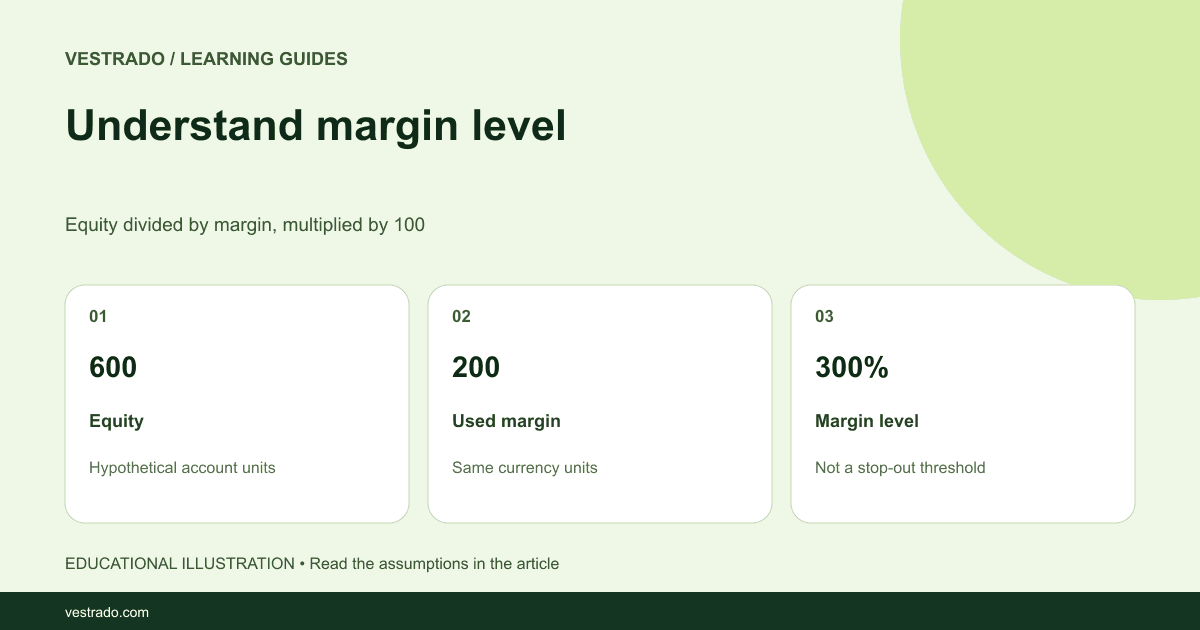
Check minimum volume and volume step; rounding upwards can exceed the written scenario. Allow for relevant costs and the possibility that execution differs from the planned exit. Margin availability is a separate check: a trade can have enough margin and still have unacceptable possible loss. Practise the worksheet with the MT5 guide and record both the planned and actual demo results.
Frequently Asked Question
Does this formula set a guaranteed loss limit?
No. It is a simplified planned scenario. Gaps, execution, costs and conversion can change the final outcome.
Further reading
Compare the current account conditions and leverage and margin information alongside this explanation. Examples are hypothetical, not live prices, Vestrado contract specifications or recommendations for your account.
Trading forex and CFDs involves risk. This educational article does not establish that a product, position size or strategy is suitable for you.

Start your trading journey
Choose flexible trading conditions based on your experience, strategy and trading goals.