
On this page
Margin level compares equity with used margin. It helps describe account conditions, but it is not a personal risk budget or a promise that losses stop at a certain amount.
Calculate a ratio with matching units
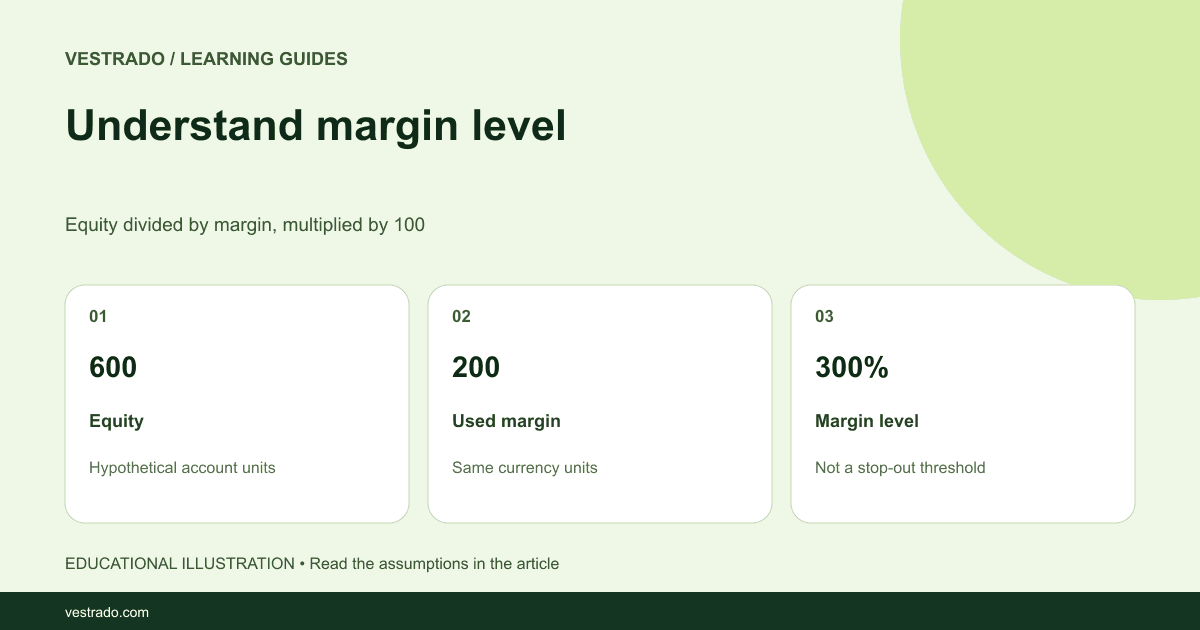
In a simplified account snapshot, margin level is equity divided by used margin, multiplied by 100. With equity of 600 and margin of 200, the result is 300%. If equity falls to 150 while the same margin remains, it becomes 75%. When used margin is zero, the ordinary division is not meaningful; check how the platform displays the account.
Separate warning from liquidation rules
Margin-call and stop-out settings depend on the account and applicable conditions. Do not copy a threshold from another provider or treat a warning as permission to keep increasing exposure. Position closure can change both equity and required margin. A simplified ratio does not predict exactly which position will close first or what its final fill will be.
A threshold example is not an account specification
For arithmetic only, imagine an account whose stop-out condition is expressed as a margin level of 50%. This is an invented threshold, not a Vestrado setting. With used margin fixed at 200 currency units, equity of 100 gives 50% because 100 divided by 200, multiplied by 100, equals 50. At equity of 150 the level is 75%, but that does not identify how much additional market movement would take equity to 100. The open instruments, volumes, costs and conversions are still needed.
The worksheet assumes margin remains 200. If new exposure increases used margin to 400 while equity remains 600, margin level falls from 300% to 150% without any change in equity in that simplified snapshot. A lower ratio can therefore reflect a changing denominator as well as a floating loss. Check both figures before explaining a movement in the percentage.
Why a closure can change the ratio
Consider a separate invented snapshot with equity of 90 and margin of 200: margin level is 45%. Suppose a position closes at the valuation already reflected in equity, there are no new charges or price changes, and total reserved margin falls to 100. Equity remains 90 in that simplified transition, so the new margin level is 90%. The higher percentage does not mean the loss was recovered; less margin is reserved.
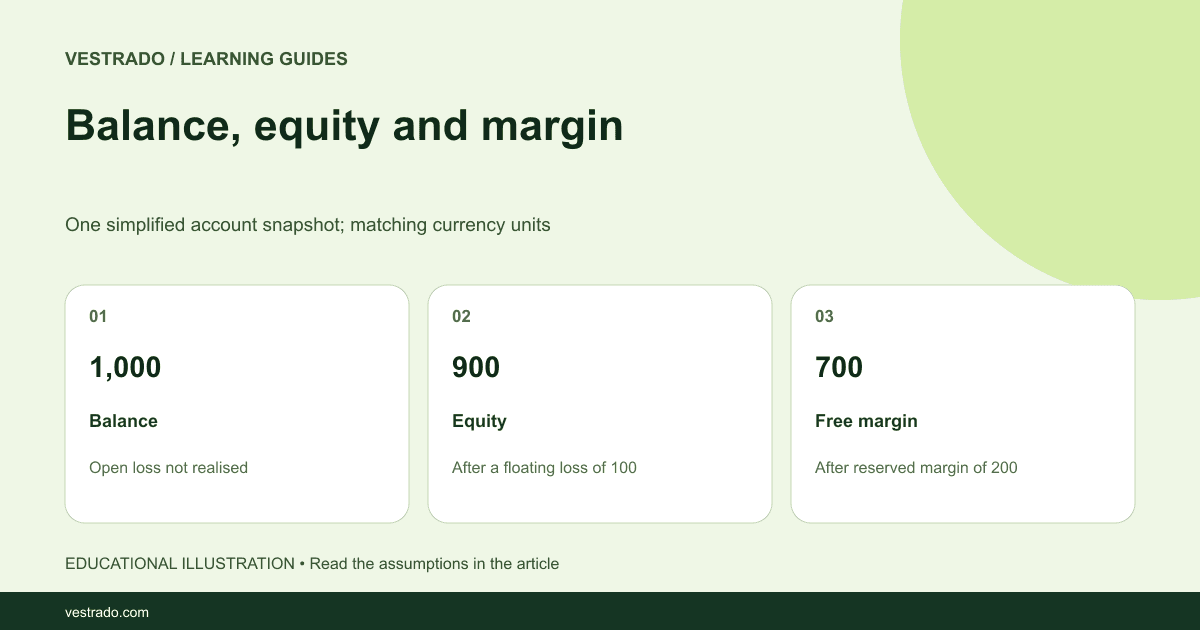
That exercise does not describe a universal liquidation sequence. Actual closure order, calculation mode, execution prices and remaining positions can produce a different result. Account stop-out settings can also be expressed using different modes, so do not treat every account's setting as the percentage used in this example. The balance and equity walkthrough explains why realised losses and released margin need separate treatment.
Record the rule as well as the number
In a demo worksheet, record the date, account currency, equity, used margin and displayed percentage together. Separately record the source of the applicable warning and stop-out rules. If the available terms do not identify the threshold or calculation mode clearly, ask support for clarification instead of importing a number from an unrelated account. A monitoring worksheet is for understanding account behaviour; deliberately forcing liquidation is not required to learn the formula.
Make a monitoring worksheet
Record equity, margin, open exposure, account currency and the current terms. Recalculate a hypothetical adverse-price scenario while keeping every assumption explicit. Check whether the platform uses additional credits or charges that your simplified calculation omitted. Review the leverage page alongside your actual account terms, and practise observing the fields on demo rather than deliberately approaching stop-out with live money.
Frequently Asked Question
Does 100% margin level always mean stop-out?
No. Do not assume a universal threshold. Confirm the rules for the specific account and instrument, including how the broker calculates the relevant values.
Further reading
Compare the current account conditions and leverage and margin information alongside this explanation. Examples are hypothetical, not live prices, Vestrado contract specifications or recommendations for your account.
Trading forex and CFDs involves risk. This educational article does not establish that a product, position size or strategy is suitable for you.

Start your trading journey
Choose flexible trading conditions based on your experience, strategy and trading goals.